IMI Data Shows EV Training Stall at Same Time as Sales Accelerate
IMI Reports
Rising just 6% on the previous quarter, the EV qualification rate is failing to keep pace with EV demand, putting workforce and motorist safety at risk
The latest EV TechSafe Technician Forecast from the Institute of the Motor Industry (IMI) underlines the urgent need for change to keep the workforce and road users safe as vehicles become more complex. While the number of electric vehicles (EVs) on UK roads is increasing, just 35% of technicians are qualified to repair and service them safely.
Key findings
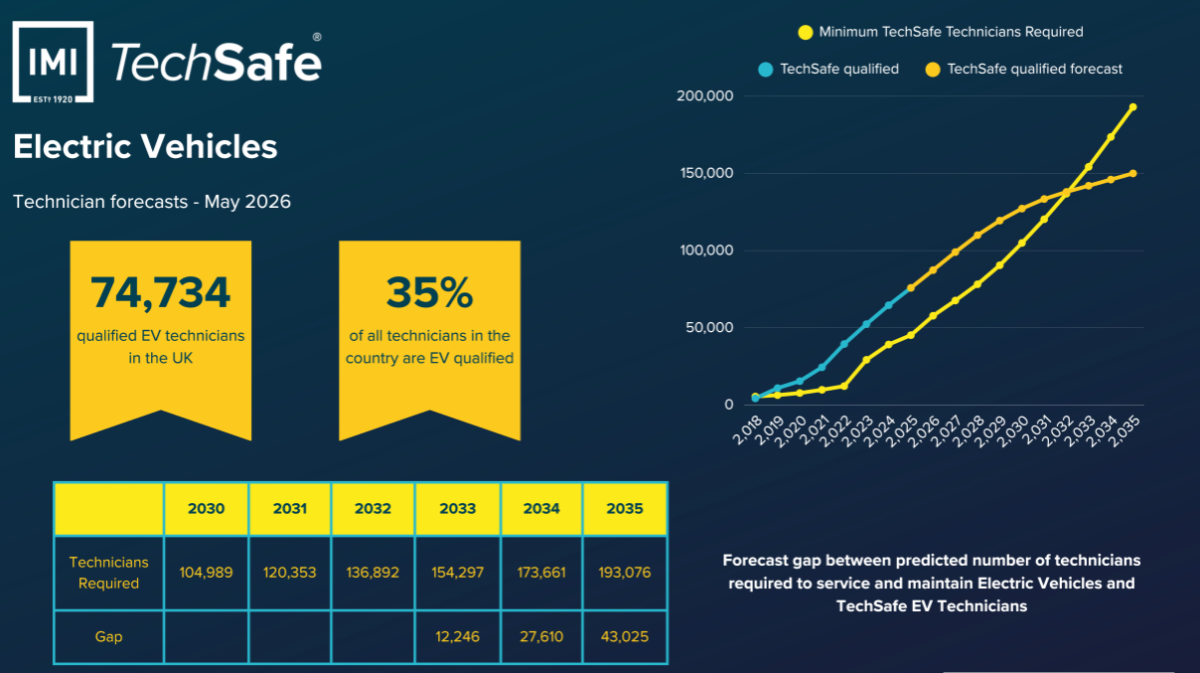
- 2,792 technicians gained an EV qualification in Q4 2025
- This is 6% higher than Q3 2025, but 17% lower than the same period in 2024
- 74,734 technicians or 35% of the UK technician workforce is EV qualified
- The IMI expects around 2,394 new certifications in Q1 2026
- Projected demand could exceed supply by more than 43,000 technicians by 2035
The IMI is continuing to call on the government to mandate IMI TechSafe to ensure both the automotive workforce and UK road users remain safe. While it's already recognised as the practical mechanism to audit workforce competence, it could, therefore, be the right solution to help government, industry and the public manage the risks and opportunities of new vehicle technologies.
In a recent panel discussion the IMI hosted for industry leaders, attended by the Shadow Secretary of State for Transport, the future of automotive workforce safety was debated. The meeting unanimously agreed that increasingly technologically complex vehicles demand government action to ensure the people maintaining, repairing, diagnosing and recovering them are competent to do so. The IMI TechSafe standard was identified as the best mechanism to deliver this with the IMI calling on government to mandate its use across four rapidly evolving areas of the automotive sector.
Emma Carrigy, Head of Research and Public Affairs at the IMI commented:
"EV technician numbers are still rising, but at a comparatively slower rate year-on-year, and not quickly enough to meet projected demand. Without a faster increase in training uptake, there is a very serious risk that technician availability will become a barrier to EV adoption, slowing the UK's transition zero emissions. Pressure on technician capacity is already increasing and there is now a very limited window in which to expand training, support employers and encourage more technicians to enter EV repair and maintenance roles."
IMI forecasts predict continued growth in EV certification over the next decade, with the number of EV-qualified technicians projected to reach around 137,000 by 2032 and 193,000 by 2035. However, projected demand continues to rise at a faster rate. The gap between technician supply and demand increases sharply from the early 2030s, with shortages beginning in 2033 and growing year by year. By 2035, the projected shortfall rises to more than 43,000 technicians.
"Unless this qualification trajectory changes dramatically, there will be a dangerous skills shortfall in just five years – just in time for the sale of new petrol and diesel vehicles to be phased out," Emma Carrigy, continued. "This data underlines the urgency for a solution to ensure both the automotive workforce and UK road users remain safe."