Considering the Past as a Guide to the Future - UK -Europe Trade
Consideration for Commercial Traffic
Using over 50 years commercial export and import experience in trade the Colin Dunham has compiled some of the different choices that face the UK for trade options with a focus on the South East. To add depth he has reflected on what has bought the UK to this point and the various ideas that have been considered previously and are in many cases still up for current discussion.
Wherever we travel congestion seems to be an accepted fact of life, to be tolerated, endured and at peak periods and in other circumstances expected. Whether at airports, mainline railway stations, in town centres, on the M25, at the Dartford crossing and other pinch points it’s a case of like it or lump it when we should not have to do either.
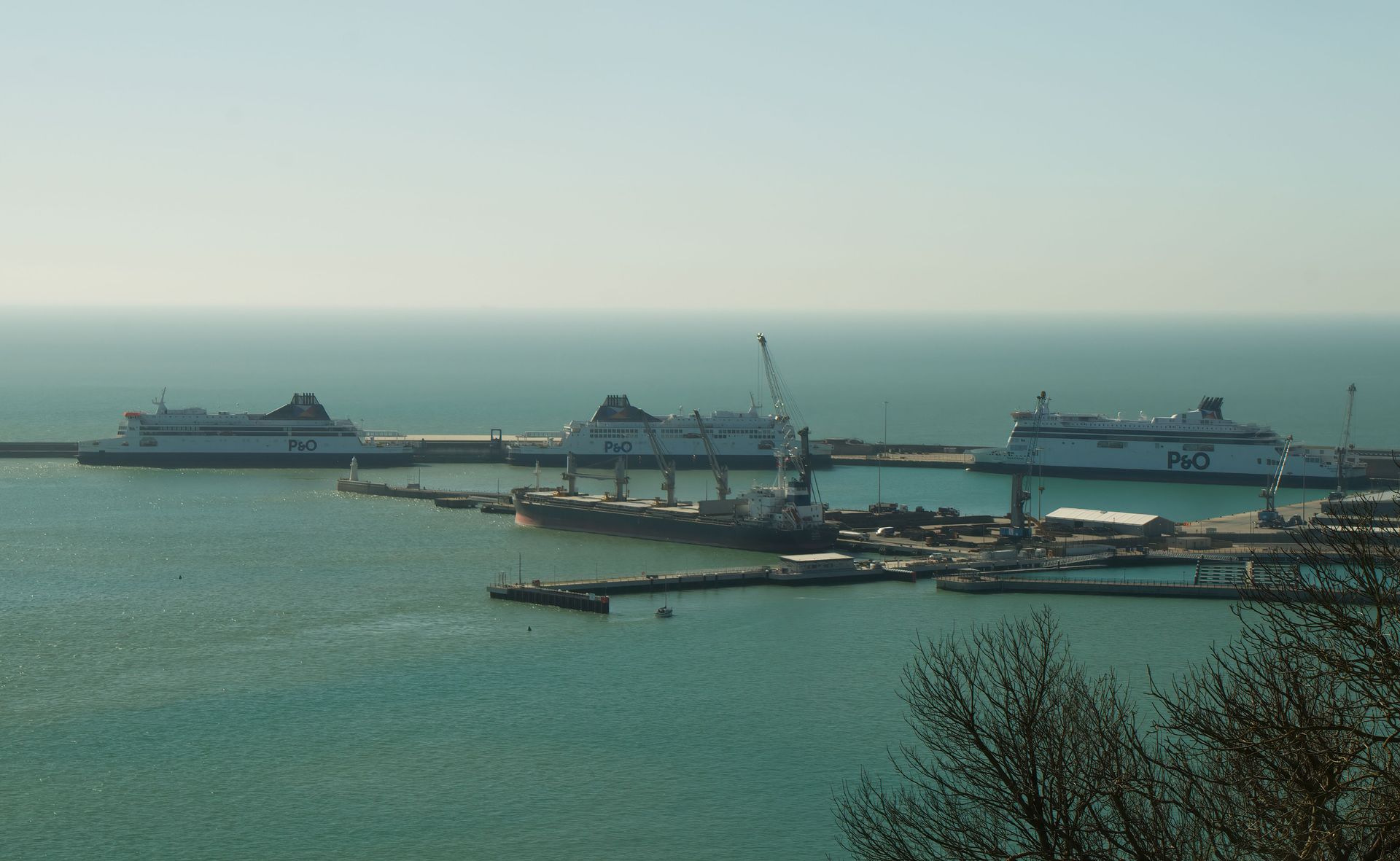
The Port of Dover and surrounding areas is the subject of this article, where every year there is traffic congestion, gridlock and sometimes associated anti-social behaviour, exacerbated at known peak times and always with the potential at other times.
The reasons for this include:-
- Predictable peak holiday traffic & road works
- Less predictable adverse weather in the Channel and traffic accidents on the approaches
- Industrial disputes. More commonly occurring in France which may or may not be predicable
Congestion causes frustration and extra costs to commercial transport operators, holiday travellers passing through, residents, retailers and employees of the organisation providing services in and around the Port.
Significant efforts have and continue to be made by the Dover Port Authority, local and Kent Councils, the Department of Transport and many other organisations, to find a permanent solution or at least manage and reduce the impact. Operation Stack, Bloc, Manston, more and larger holding areas, with temporary restrictions on entry etc. These have mixed results and satisfaction depending on your point of view.
It may be fascinating to look back on how the Port of Dover has developed from Roman times to the present day but this is a not the purpose of this article. Rather it is intended.to consider where we are to-day, where we are going and might be in 5/10 years’ time. To hopefully promote and expand discussion about what else, however controversial, could be done to facilitate transit.
Although congestion affects all users the main consideration in this article is for commercial traffic rather than private holiday or business motorists. Although we understand what applies to one sector will also have an effect all users.
Simplistically Dover is the victim of its own success.
Foremost is its geographical location as the closest Port to mainland Europe.
Its’ long history as The Gateway to England, or if you prefer Great Britain.
Significantly shorter Channel crossing times than from other UK Ports.
Excellent connections via the French Channel Ports, to the European motorway network and beyond.
These make Dover the preferred port of exit, the result being over many years an expansion of business requiring more frequent and larger cross channel ferries and an increasing strain on the local infrastructure.
As already mentioned Dover is not unique in suffering from congestion due to demand outstripping capacity, a common factor being predictions of future use being lower than reality. But then hindsight is fine for the armchair critic but not usually available to the planners trying to assess future developments and also influenced by financial considerations.
The Channel Tunnel
When the Channel Tunnel was opened some said it would adversely affect ferry services using Kent Ports. In the case of Dover this has not happened – quite the opposite. Initially some freight agents serving the Port lost out but there were other reasons for this including the effects of the EU Customs Union and Free Market. Rather, there was a growth in competition between the ferry and the Tunnel operators, stimulated by aggressive marketing. This increased the choice for commercial operators and the private motorist to choose to use the service which was most convenient and cost effective at any time.
As cross channel traffic through Dover and the Tunnel increased so did the negative effect on the alternative ports of Ramsgate, Sheerness and Folkestone. Decreasing traffic through these meant declining revenue for the operators who still had to bear the full costs of maintaining their services and infrastructure.
Brexit
BREXIT is cited by some as the reason for the current delays and clearly new regulatory controls which have and are being introduced have had an effect.
However there were logistical problems as long ago as the 1970/80s, when the UK was a member of the EU, and before the full implementation of the Customs Union and Single Market. Delays even then were a cause for concern; IT systems being in the early stages of development and implementation. Exporters, agents and Customs relied on paper based systems with separate forms to be completed for, customs export, T1 - T2 or T2L for transit and customs import entry at destination
This was simplified by the introduction of the Single Administrative Document (SAD) which completed by the Exporter or Freight agent combined all of these functions in one form. From the late 1970s the SAD could also serve as the pre-shipment declaration under the Customs Assigned Number System (CAN), introduced as an alternative to the proposed mandatory Custom Pre-Entry.
At this time there was excellent cooperation between all parties in the EU directly concerning with facilitating cross border trade. In the UK the Simplification of International Trade Procedures Board (SITPRO) was the catalyst for this, assisting in the setting up of similar organisation in other Member States and other countries including Japan. All working with the UN trade facilitation committee in Geneva, with the common aim of simplifying and promoting international trade.
Purely from the UK view point, even with the establishment of the Custom Union and Single Market, trading was not a level playing field. Whilst the establishment of the Customs Union and Single Market did encourage more UK businesses to sell in Europe many more did not. Some of the reasons being, geography, deep seated attitudes which saw exporting as too complex, a perceived sufficient home market, lack of post war investment in industrial modernisation and so forth.
A bone of contention often stated was that although the UK was the second/third largest contributor to the EU we were at always paying more in than receiving back. Before the Brexit vote there were opportunities to redress this imbalance, notably under the Blair and Cameron Governments. The former even giving away some of the rebate on our contributions negotiated under Thatcher. Cameron, when trying to negotiate improvements, was unable to achieve any change to the status quo. Had these succeeded a more positive outcome might have even led to there being no need for Brexit.
However the decision having been taken, some took the view that the then Conservative Government and opposition had a less than warm approach to implementation. Subsequent negotiations it seemed to have more emphasis on control of the borders and restrictions on trade. One view being that negotiations were more about proving the decision taken by the electorate wrong, rather than reaching an equitable agreement.
Had the negotiations been conducted in the spirit of the 1970s simplifications, as previously mentioned and led by those most experienced in day to day logistics, then a far more open minded approach to facilitating free trade between the UK and other EU States should have been possible. Pre-eminent in the discussions should have been that the UK was not only a nett contributor but also bought more from the other Member States than they did from us.
What is a Gateway for Transport Logistics?
We start with the definition of Dover as the Gateway to England. A gateway should be a point of entry or exit and a swift and easy means of access or departure. Not of control and delay, at least insofar as the movement of non-controlled goods are concerned. Even where there is the need for some control, this does not always have to be at the port of entry or exit. Although provision must always be made for port based inspection for some goods; health, drug control, prohibited weapons etc.
It is surely more efficient if goods move from the point of loading in the export country to point of unloading in the destination country as quickly as possible with the minimum of interruption between. This should be so for full loads from one exporter to one importer and groupage consignments between accredited freight agents and consolidators in the countries of departure and destination.
Local Export and Import Control
In the mid-1970s UK HMC, introduced Local Export Control (LEC) and Local Import control (LIC) which allowed registered exporters, importers and agents to complete customs formalities at their premises. They just notified their local customs officer of departure and arrival, clearance usually being granted over the telephone, after a specified time lapse, usually without the need for personal attendance by the Customs Officer. Although there was always the option to attend before clearance was granted and make physical checks.
A procedure backed up by unannounced as well as regular visits for documentary audit. As well as non-controlled goods, some controlled goods such as those subject to inward and outward processing relief were .included in this arrangement. Effective means of enforcing the rules being part of these concessions.
This facility was generally withdrawn in the UK some years ago in favour of port based clearance. Could it be reintroduced? Well a key feature of this procedure was an excellent network local Customs Officers. These were often very experienced ex-shipping and landing personnel who had been transferred when, with the advent of containerisation the traditional docks closed and streamlined container facilities established. Unfortunately these local officers have largely disappeared through reorganisation and centralisation.
However the wider and much improved use of IT systems should not preclude this system of local clearance and control being considered for reintroduction. It would also require experienced commercial export/import staff to ensure proper compliance with the regulations. These do exist but much more needs to be done to increase, recognise and reward staff and encourage shippers and agents to take full advantage of customs procedures available.
Keeping Dover Clear
When congestion is anticipated in Dover instead of stacking a large number of commercial vehicles on the immediate approach roads and surrounding areas, could this not be done at holding areas further away from the Port? Possibly on brown field sites or unused Thames side land in north Kent or south Essex, ideally close to the Dartford Crossing?
Vehicles held in these areas being given a “call forward” number to proceed as traffic flow conditions permit. Advance notification of this arrangement being given through traffic advice systems similar to those which already exist. Customs procedures could also be completed at these sites. Vehicles called forward then having an uninterrupted journey through Dover and onto the ferry loading areas.
Vehicles which arrived in the Port without the call forward authority would be turned round sent back to a holding area.
Inland clearance has been reintroduced at the recently constructed Sevington, Ashford lorry
Park, which has comprehensive facilities including Customs, so there, is a precedent. However there are some reports that incoming vehicles routed from Dover just pass this by.
There were also plans to establish similar depots at other points including Ebbsfleet but it would seem the preference has been for temporary holding points with limited facilities, not including Customs. As these are generally in East Kent, close to Dover they are not really an answer to the local problems. Rather dispersal /holding areas should, as suggested, be further back.
Lower Thames Crossing. (LTC)
Government has authorised construction and preliminary work has now started. Current publicity is all about this solving the problem of congestion at the Dartford Crossing. Whilst this may happen in the short term experience may perhaps prove otherwise. As has been seen elsewhere future demand has a habit or exceeding expected available capacity.
Even in these early days of construction the effects of LTC on Dover and the wider areas of Kent needs to be considered as what could happen might be:-
An increase in traffic using LTC as a shorter alternative to Europe via Dover than from other UK ferry ports.
Such an increase causing more congestion in Dover as well as an adverse effect on traffic on the M2, M20 and other access routes
Pinch points on the connection with the A2/M2 with traffic tailing back to the LTC and surrounding roads.
These factors and the normal growth in traffic flows may well mean in 10 years’ time or less we will find the LTC is together with the Dartford crossing again approaching gridlock.
As part of the construction process at the Kent and Essex ends of the crossing large areas are being prepared for the equipment etc. to be used in the project. When construction is finished these areas might well be, be used as Custom clearance and control points to regulate the flow of vehicles through Dover
Demand and Capacity
Across the country our major road networks already have the problem of demand exceeding capacity, even when all is running reasonably well. A situation made worse when even a relative minor incident occurs. The introduction of the smart motorway scheme being seen as a low cost partial solution to this but which, although cited as cost effective, has proved to be the cause of a number of fatalities and serious injuries. What price a human life?
The geography of our country is such that there is a limit to expanding the road network and ad hoc schemes to deal with ever growing demand. So perhaps more fanciful ideas could be considered?
Instead of a road crossing make the Lower Thames Crossing a rail link connected to the high speed national rail network in Essex and Kent and through this with other parts of the system across the country. There would seem to be extra capacity already and scope for expansion by adding to the network, including reopening some of that closed after “Beeching”
Could the Le Shuttle Service be extended to other parts of the country with vehicles being loaded at inland points and routed direct through the Channel Tunnel?
A system implemented whereby when congestion is or is anticipated in Dover vehicles are diverted to other ports of exit.
Restrictions placed on the vehicles which can use Dover Port. For example empty vehicles which might be required use to other UK ports.
Summary
To sum up should consideration be given to?
The reintroduction of and encourage use of Local Export and Import Control at traders and agents premises
Establish control and customs clearance holding areas away from Dover
Encourage more use of other ports for certain journeys or goods where time is not the critical factor
Consider encouraging vehicles that are returning empty being routed via alternative ports. Possibly with a financial benefit.
Rethink the dependency on through road traffic by extending the use of rail for all or part of the cross channel journey.
Avoiding the one size fits all approach and continuing to route more and more road traffic through Dover. Taking the dispersal rather than centralised approach.